HDMI
Until now we have been creating VGA signals, which are
- Red
- Green
- Blue
- Horizontal Sync
- Vertical Sync
HDMI (High-Definition Multimedia Interface) uses the same signals, but there is some encoding to be done. The 8 bits of each color are encoded to 10-bits, this format is called 8b/10b.
8b10b encoding
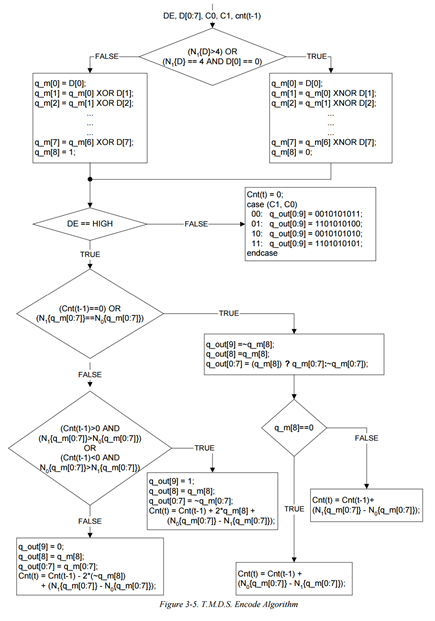
Transition minimizing
The 9-th bit is for minization of the transitions (0-to-1 or 1-to-0), this is done using XOR and XNOR, each bit is the XOR/XNOR of itself with the encoded version of the previous bit.
- Fewer than 4 ones, use XOR
- More than 4 ones, use XNOR
- Exactly 4 ones, start with 1 use XOR, start with 0 use XNOR
This extra data allows a better signal-to-noise ratio.
TMDS stands for Transition-minimized differential signalling. Using the 8b/10b encoding algorithm, the transitions from 0 to 1 or from 1 to 0 are minimized in the data to be transmitted. Fast changing data would create electromagnetic interference (EMI) that distorts the surrounding signalling cables.
DC bias
The 10-th bit is used to maintain DC bias, since the outcome of the 9th-bit encoding does not guarantee an even number of ones and zeros, to create a net amplitude of zero. The encoding for the 10-th bit may invert all previous 9 bits and add a 1 if inverted or a 0 if not inverted. This will ensure to maintain DC bias. Otherwise capacitance might build up and this can cause many problems regarding signal quality.
Differential signalling
TMDS is similar to LVDS (low voltage differential signaling) in that it uses differential signalling, this means there are 2 lines for each signal (positive and negative). This will provide better resistance to noise from external sources. The pair is twisted to further minimize noise.
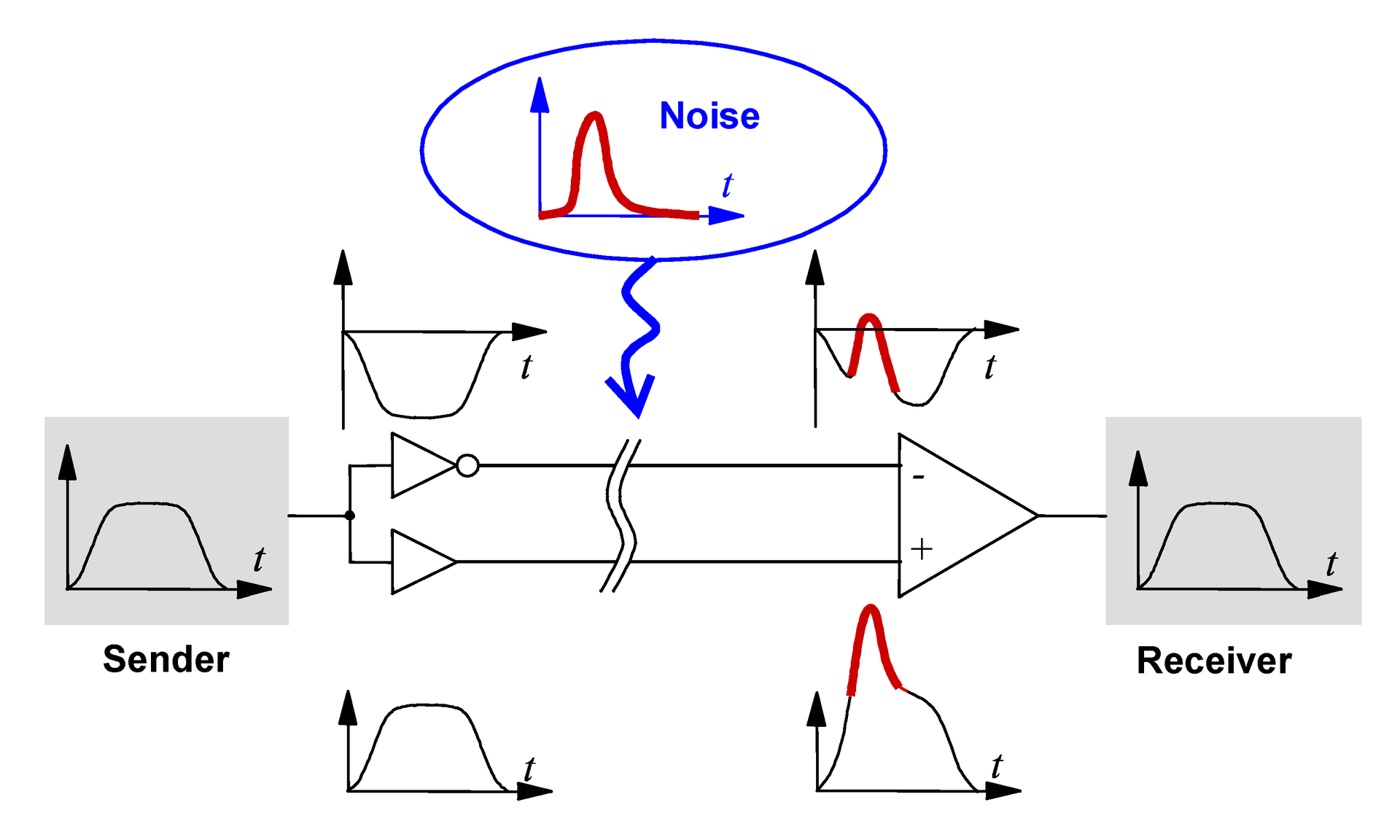
If noise has been picked up, it will disappear when inverting the negative signal and adding that to the positive signal since the noise gets negated on the n-wire (upper wire on the diagram) and added to the noise on the p-wire.
Horizontal Sync and Vertical Sync are sent as control bits with the blue signal (which is channel 0, green is channel 1, red is channel 2) during TMDS encoding.

HDMI-CEC
HDMI also has some control signals:
- Remote Control Pass-Through (remote control commands to other devices)
- One-Touch Play (switches TV to HDMI)
- Routing Control (control input source selection)
Digilent IP Repository
The ip block we provided previous week appears to be giving issues sometimes, this is because it is an implementation of a very small subset of the HDMI 1.3 specification, which can be found online (the latest version of the specs is not free).
A better solution might be to use Digilent's Vivado IP repository. By cloning this repository and adding the folder as an IP repository in Vivado/Settings/IP/Repository, you will be able to add the rgb2dvi IP.
DVI signals are similar to HDMI, but HDMI has a lot of extras, like Data Islands (during blanking period Audio packets or other data can be sent).
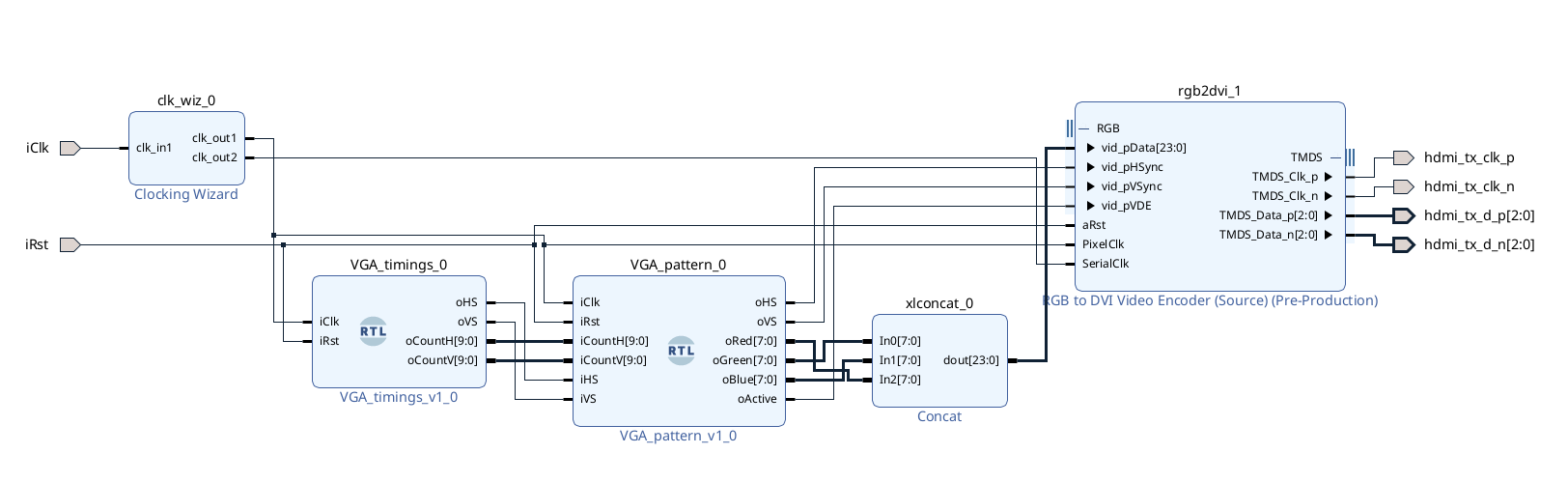
If you would like to try different resolutions, have a look at the timings here. Keep in mind the max TMDS clock will be around 650 MHz.
Though there is a trick to consider...
If you get an HDMI input signal, you can steal the TMDS clock using dvi2rgb, next update part of the pixels and reinsert the updated pixels using rgb2dvi and send out an HDMI 1080p signal.
Verilog
Verilog code and some more explanation can be found on Jeremy See's website and FPGA4Fun